Invcity Editorial Desk
How a steel town became one of Invcity's most-searched places
Adityapur doesn't appear on most tourist maps, but it's one of the highest-traffic entities on Invcity. The story of how a planned industrial township grew around Jamshedpur's ancillary belt — and why that history still shapes how people search for it today.
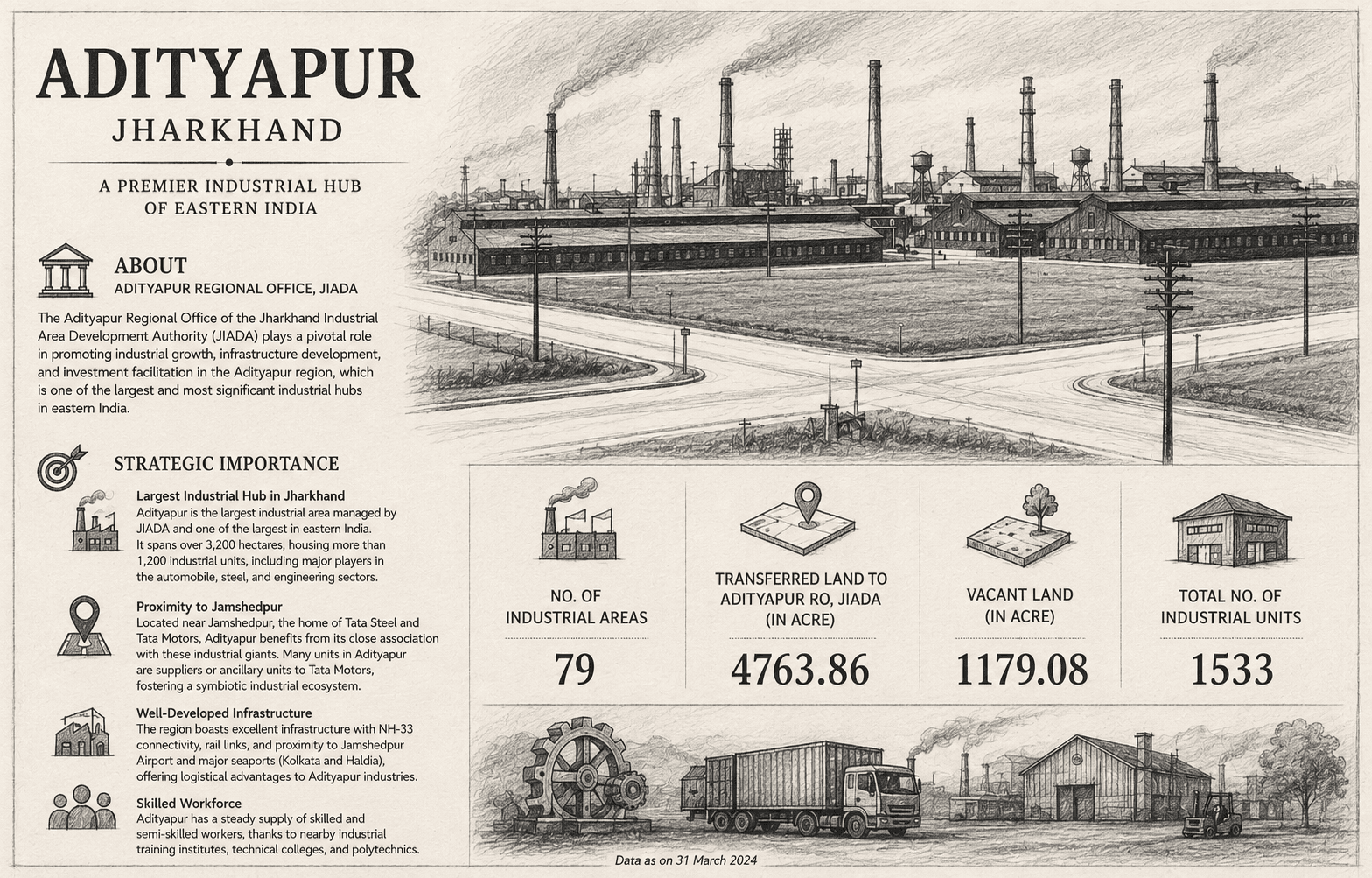
Adityapur doesn't show up on most tourist maps of India. It has no fort, no promenade, no heritage quarter written up in a guidebook. And yet inside Invcity's own graph, it is one of the most searched, most linked, most structurally significant places in the eastern half of the country — a node with more edges connecting into it than cities ten times its population.
The reason is simple once you see it: Adityapur isn't a place people visit. It's a place things move through.
A city built to make things
Adityapur sits in Jharkhand's Seraikela-Kharsawan district, on the western bank of the Kharkai river, directly across from Jamshedpur. It was never planned as a town in the usual sense — a market square that grew outward, a temple town that accreted housing around it. It was planned as capacity: land set aside specifically to absorb the ancillary industry that a steel city the size of Jamshedpur inevitably throws off.
That plan worked almost too well. Today the Adityapur industrial belt run by JIADA — the Jharkhand Industrial Area Development Authority — covers more than 3,200 hectares and hosts over 1,200 registered industrial units, from small forging shops to large-scale auto component manufacturers. It is one of the densest concentrations of ancillary manufacturing anywhere in eastern India, and almost none of it exists for its own sake. It exists because Tata Steel and Tata Motors exist twenty minutes away, and every large industrial anchor needs a thousand smaller businesses willing to make the parts it doesn't want to make itself.
Adityapur does not merely sit beside industry — it is one of the places where industry becomes a city.
Why the search behavior is different here
Most Indian cities get searched the way a person plans a visit: "things to do in," "best time to visit," "how to reach." Adityapur's search pattern looks nothing like that. People search for supplier lists, for PIN codes, for which post office serves which industrial plot, for whether a specific street falls inside Adityapur Municipal Corporation or spills into neighbouring jurisdiction. It is the search behaviour of people doing business, not people planning a holiday — logistics managers, component buyers, workers checking a commute, families relocating for a factory job.
That's also why a tool as unglamorous as a postal code lookup matters more here than almost anywhere else on the platform. In a city organized around industrial plot numbers and supply chains rather than neighbourhoods and landmarks, the PIN code often is the address that resolves an ambiguous factory location — which is exactly the kind of routing problem Invcity's postal geography dataset was built to solve.
The river, the road, and the reason it's still growing
Geography did as much work here as policy. The Kharkai river gave the site water and a natural boundary; the road and rail corridors linking Jamshedpur to the rest of the country gave it logistics. Together they meant that when Tata's ancillary demand outgrew Jamshedpur's own land, Adityapur was the obvious pressure valve — close enough to stay inside the same labour market, far enough to have room to build at industrial scale.
That growth hasn't stopped. Newer manufacturing — auto components, engineering fabrication, MSME clusters feeding into larger contracts — keeps arriving for the same reason the first wave did: proximity to an anchor industry, decent connectivity, and land that was zoned for exactly this from the start.
Most guides to India skip places like Adityapur entirely, because a "things to see" framing has nothing to offer here. But if you're trying to actually understand how the country's industrial economy is wired together — which cities feed which factories, which supply chains touch which post offices — Adityapur is one of the clearest examples on the map. It's not a place you visit. It's a place you route through, and increasingly, a place you search.